Hello!
Today’s post is not about jewelry, it’s about antiques and chocolate. Of course I love talking about jewelry, but antiques and chocolate rank right up there as well. If you like to bake, then surely you’ve heard of Baker’s chocolate. Somehow Luckett’s led me to that kind of chocolate.
As if going to a great big bead show with a friend on Saturday wasn’t enough, I had the good fortune of attending Luckett’s annual Spring Market as well. With 2 kids off at the beach with Grandparents, and another on a Boy Scouts camping trip, it was just me and my two year old son with a sunny afternoon ahead of us. We were ready to shop for treasures at the outdoor show. I was hoping to meet a few blogging friends there but we narrowly missed one another.

The market was packed; it was plain to see the crowds are growing larger every year. Apparently 70 vendors were added this year. Arriving in the afternoon, I saw many red “sold” signs – a sign no antiquer wants to see. I did find many little treasures however, the largest item being a toy dresser. It was big on charm and the price was great, so I couldn’t resist. I bought my first miniature dresser back in January, so does this mean I officially have a collection? I think these sweet chests would make a great jewelry box, or even just a prop for my pictures. I’m afraid my studio is quickly becoming one big prop warehouse.

Do any of you collect vintage compacts? I bet that is a huge niche in collecting. I have seen many beautiful examples. When I saw this one, I couldn’t resist…

And now for the 3rd new-on-my-lookout-list-while-antiquing: Half Dolls. Have you seen them? When I would see them in their unadorned half-doll state, they never really caught my attention. I’ve admired the pincushions (must be the tattered fabric and lace) however, and just recently realized they are categorized as Half Dolls. What are Half Dolls (also known as tea-cosie and dresser dolls)? Made from bisque or porcelain, Half Dolls were made by the thousands and popular from the early 1900s to 1930’s, and were made in Germany, France, Bavaria, America and Japan. Half Dolls were often attached at the waist to a pincushion, a crumb broom, or to cover a tea pot with its skirt. Older dolls reflected the skills of their maker, were hand-painted, and some from more complex molds than others. I’ve learned how the position of the arms can help determine the value of the doll. With the advance of technology, later dolls were mass-produced and became more affordable. Now this is where I explain how chocolate came in to the picture.

As it turns out, the most sought-after doll was created by the Goebel porcelain factory for Walter Baker chocolate in 1975 for advertising. These “chocolate ladies” hold a cup or tray of cocoa and are now rare finds. The lady in the Baker’s chocolate logo is known as La Belle Chocolatiere, and her history can be found on the Baker’s website. When Henry L. Pierce (then President of Walter Baking & Company) saw the painting of Princess Dietrichstein in the Dresden Art Gallery, he thought the image would represent Baker’s Chocolate well.
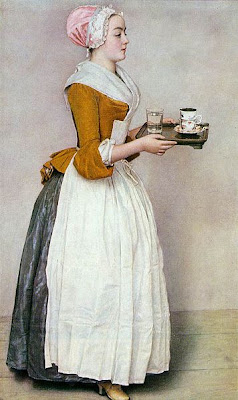

“…There is a romance connected with the charming Viennese girl who served as the model, which is well worth telling. One of the leading journals of Vienna has thrown some light an the Baltauf, or Baldauf, family to which the subject of Liotard’s painting belonged. Anna, or Annerl, as she was called by friends and relatives, was the daughter of Melchior Baltauf, a knight, who was living in Vienna in 1760, when Liotard was in that city making portraits of some members of the Austrian Court. It is not clear whether Anna was earning her living as a chocolate bearer at that time or whether she posed as a society belle in that becoming costume; but, be that as it may, her beauty won the love of a prince of the Empire, whose name, Dietrichstein, is known now only because he married the charming girl who was immortalized by a great artist. The marriage caused a great deal of talk in Austrian society at the time, and many different stories have been told about it. The prejudices of caste have always been very strong in Vienna, and a daughter of a knight, even if well-to-do, was not considered a suitable match for a member of the court. It is said that an the wedding day Anna invited the chocolate bearers with whom she had worked or played, and in “sportive joy at her own elevation” offered her hand to them saying, ” Behold! now that I am a princess you may kiss my hand.”She was probably about twenty years of age when the portrait was painted in 1760, and she lived until 1825…”
I know I’ll never look at those boxes of Baker’s chocolate in quite the same way. AND I’ll be on the look-out for a Half Doll carrying a tray of cocoa.
Thank you for bearing with me through this long and winding tale of how antiquing led me to little history lesson – even if it was chocolate history.